A rabbit showed up one day during the COVID lockdown in 2020. Free to come and go as he pleased, not wearing a mask, not waiting desperately for a vaccine, not even worried about his friends, it was just a solitary gray rabbit in our back yard.
I was living with my son at the time and we were amusing ourselves at home. We never tried baking sourdough, although I do have an idea I might try it now that it doesn’t matter. Day after day, I was watching hour-long tutorials on how to crochet. I am a diehard knitter though, so crochet, in my view, is for other people.
Then, one day, this cocky rabbit hopped in. He sat stock still in the back yard under my bedroom window for the longest time. To be truthful, tracking a rabbit was an excuse to put down the yarn and do anything else. I was fascinated. I know pretty much zero about rabbits, or any backyard animals, for that matter, having lived in New York City for 40 years. So, I watched him. We called him Bun Man. Calling him Bunny seemed a tad too friendly on our part, same for Peter. And no, Alice in Wonderland lovers, he did not keep checking a pocket watch.
But let’s be honest here too: during those fateful first months of the pandemic, we looked for any distraction: from watching Governor Cuomo give updates from New York, to watching Dr. Fauci and that Scarf Lady squirm on national TV from the podium in the White House press room. We all learned to Zoom and Bun Man made near daily visits to the yard.
My yard is roughly one-part wild strawberries, one-part chives, one-part green grass – and, to me, that suddenly sounds like a salad for a rabbit. Because I know nothing about rabbits, I couldn’t tell if “it” was a mom or a dad, so I promoted it to Bun Man, which was meant to be like “Look at you! You da man, rabbit!”
The little I do know about rabbits is linked to Easter. We eat chocolate ones. Hollow is easy to eat, but the bunny goes fast. You might find yourself gnawing on the solid ones for a while, but let’s face it, taking the head off can be a bit disconcerting.
Bun Man stopped coming by sometime that June. I would look for he/him, she/her but unless Bun Man wanted me to see him/her, it was a bust. I slipped a brick under the gap in the fence and thought maybe it would keep him out because my friends were telling me scary lawn stories about rogue rabbits chewing up the place, and I fell into line, thinking, “Oh my, that’s sounds bad,” even though my Bun Man seemed rather disinterested in making ungainly inroads in my yard. He just looked hungry. A back yard gourmand.
The pandemic waned, we all got one shot after another, and then went back to spending more time out of the house than in. I’d mostly forgotten about him. Still, when I was in, I was likely looking out the window into the yard to see if there was a rabbit there.
But then, just last month, Bun Man came back. I’m not sure what made me look out – I was making lunch – and there he was, sitting mid-yard snacking on the strawberries, before taking off again, I would guess.
So, what is it about ephemera that makes us want it more than things that stick around? It’s clearly the transitory nature of the thing, like ticket stubs we keep, flowers we dry and flatten in the pages of a book, champagne corks in kitchen drawers. They are memory aids, I guess, reminding us that the event that brought us the stubs, the flowers, or the champagne is gone to our memory now. As you get older, you come to realize that it’s never safe there, so having the object allows us to prompt something that will bring it to the surface. And I guess it’s that for a few months in 2020, we had Bun Man to look out for. Bun Man was actually what Taylor Swift might call “a mythical thing.”
Of course, I gave up crochet, and the pandemic seems so long ago now. I do not want ever to shelter in place again; so much in those early months was frightening and horrific. But something brought us all together, forgetting to unmute ourselves on Zoom, laughing at Sarah Cooper videos, sympathizing with Dr. Fauci, staying home, swearing at crochet videos, and hoping someone would leave some freshly baked sourdough bread on the front porch. Bun Man was a part of it. He’s my champagne cork to a selective memory now.
You da man, rabbit.
Winner, Adult Mini Lit, 2024 Niles District Library Writing Contest
It’s easy to pinpoint the moment when I became caught up in family history research. My great aunt, Dorothy, had just died, and my dad came into possession of her collection of photos and documents. I remember it clearly. We were in the TV room on one of my visits to our house in Niles and my dad pulled a large cardboard box out of the closet. He said that she had left this box and that I might be interested in its contents. We talked about her, about the last time I’d been to see her, and I took the box. Let’s say, I took the box seriously. It clearly contained a lifetime of treasures and I suddenly felt responsible.
What happened next was what you might expect. I went through and sorted as best I could the photos and certificates, the xeroxed pages, the jewelry, and the mementos until I got it into some preliminary order. Obviously, I had more questions than answers since many of the photographs were not identified. I was guessing that the older women were likely her aunts, her mother, and in at least one photo, her grandmother. But I was enthralled. I wanted to be able to know these people. I wanted to be able to learn more about them, so I joined Ancestry dot com on a free membership and started building my family tree.
For simple clarity, I’ll call the rest of the events that lead up to my needing to write these stories “stages.” They are the key moments of discovery, and they are not unlike that PBS show with celebrities who find their ancestor was burned at the stake as a witch. I’ve got one condemned witch in my background too, but I am not a direct descendant of hers. We will call the acquisition of that box my Stage One.
Stage Two is where it got interesting in a hurry. As I compiled information on more and more people, adding them one by one to my tree with whatever information I had, mostly from my own recollection of aunts and uncles in my dad’s family, the more I would find. It’s the endless tunnel of Ancestry, I could call it. Sometimes there’s a light at the end, and sometimes, you just have to retrace your steps and start all over.
Stage Three is where I hit the proverbial pay dirt. I had no idea at the time that it would lead me to establishing kinship with kings, but I was happy with the addition of one very young man to my tree. His name is John Chilcott. And I found him by accident on Ancestry when I was sitting on my couch in the Bronx, watching Law & Order SVU in the background with my daughter.
My grandmother’s maiden name is Chartier. Her father had married a young girl named Bessie Chilcote: note that there are two common spellings of this name, Chilcott and Chilcote. I had gone back a few generations with the help of the Ancestry database and traced that family to England. But en route, this John Chilcott showed up on a marriage license in Barbados at the end of the 17th century. All the Chilcotts are in England save this one who is getting married in Barbados. I figured I had taken a wrong turn somewhere – it’s easy to do when you use this website – so I did what any amateur genealogist would do. I Googled him. And found him.
This John Chilcott was the son of a wealthy family in England when he found himself on the wrong side of history, fighting against the crown in the Monmouth Rebellion in July of 1685. He was captured when Monmouth’s men were defeated, he was convicted of treason to the Crown, and he was shipped to Barbados from Bristol Harbor, and sold into slavery. I started reading up on Monmouth and, ultimately, I was able to construct a simple timeline, going forward to my generation, for this John Chilcott.
At roughly the same time, I came across an older man posting photos on a local Facebook group called something like “Do you remember Niles, Michigan?” I do remember lots, because I was born in Niles, but the threads of discussion in this group are pointless. Let’s call this Stage Four. I messaged him and found out he was in fact a distant cousin of ours. My great grandfather and his great grandmother are brother and sister. I must have harvested a dozen black and white images from his posts and I suddenly felt connected to their story in a way I hadn’t even begun to realize.
But there were no photos of Delia, his great grandmother and my great aunt. So, I called my cousin, Marian, and whined to her that although I had found lots of wonderful pictures of the family, I had nothing of this woman and I really wanted to know what she looked like. Marian was interested and suggested I go back to this man and ask him directly, “Do you have photos of Delia?”
What followed next was astounding. He had photos of her as a young married woman, of her with her husband, Bill, their ten children, her friends, and her guests at the beach resort she owned with Bill. I was so glad I had taken Marian’s advice. It also led me to my cousins who lived only 30 minutes away from me.
I called to tell Marian the good news – that I wanted photos of Aunt Delia and then, I got photos of Aunt Delia. And Marian replied, “Yes, of course, you did. It’s the Communion of Saints.” She was calling up the spiritual, cosmic interconnection we all have with each other and with the people who have gone before us. We are all members of the Communion of Saints. And even though I was willing to chalk it up to dumb luck, that I had simply clicked on a Facebook page at random, she convinced me that there was something more out in the ether than I had acknowledged and had somehow become its beneficiary. Maybe it’s my living family aiding my research, or maybe it is these now-gone individuals themselves making sure I got the stories I was looking for – I have no idea. But I remember my dear cousin every time I hear that expression at Mass: “I believe in the Communion of Saints.”
I moved into Stage Five just a few weeks ago. I had read someplace that the Mormon ancestry teams will do research for you when you have distilled your enquiry into just one question. In other words, you need not trouble them if you haven’t done the work. I had my one question and it was about that young man who was sold into slavery in Barbados. His lands had been confiscated. My question was, “Were they, in fact, his lands?,” or was he simply bringing a hardship to his family who were now stripped of their property for his actions against the Crown? I did some digging and found that his father had died before the Rebellion, so, as the eldest of his sons, John must have owned the lands.
Now, I’ve answered my own question. But that was too easy, and never let it be said that amateur genealogists go the easy route. I simply asked, “Who owned it before this John Chilcote?” That’s when I also saw numerous references to John’s father being a lord. His grandfather was also a lord. They lived in Somerset in the southwestern area of England, on the way to Wales. Then I put it all away and left it at that. Interesting, how my ancestors were lords. What are the odds?
What are we, Stage Six now? I had sold my house in Michigan and moved back to New York, bringing with me all of my great aunt’s treasures, along with my mother’s, my dad’s, and my cousins’ memorabilia. I packed it all into roughly a dozen storage containers and only recently started going through it all. I pulled out a particularly lovely photo from the 1930’s of my grandmother’s parents, Bessie Chilcote and Edmund Chartier. And I thought, I don’t have very many old photos up in my house, let me frame this one and set it up. That was on a Friday, late June.
The next day, I was going through a family storage unit and my daughter asked if I wanted to take back a mantel clock I had given her about ten years ago. It was their wedding clock from 1896. The Chilcotes are from England, yes, but the Chartiers came to northern Indiana from Canada. It’s an important note because it was that day that I read that there is new legislation that stipulates that Canadian citizenship can now be claimed by descent; my great grandfather, who died when I was a child, had suddenly bestowed his Canadian citizenship on all of us. Four days later, it was Canada Day – July 1. And their 130th wedding anniversary. And a week later, I left for Québec City to give a talk at a conference that had been planned last year.
This is the Communion of Saints in force: the photo, the clock, their anniversary, Canada Day, of all things, and my trip to Québec.
While I was in Québec, I was able to visit a local history museum and see where my ancestors’ house had been, built by a mid-17th century sailor named Michel Chartier who had moved to North America from France during the reign of Louis XIV and which led to generations of Chartiers living on the Île d’Orléans and later near Montréal. I had closed a beautiful loop I didn’t fully appreciate was there.
Then I went back to see what more I could find about the Chilcotes, all the while I am eternally grateful to my dear great aunt for sending me into this treasure trove of stories about the people in my family I never would have known about any other way.
As I start to see more and more information about John Chilcote’s lordly father, grandfather, great grandfather, it suddenly becomes easier and easier to find stories, connections, published genealogies – all of which I innocently attribute to his simply being a lord. I had determined that a lord likely married a woman from another wealthy family and, in this business of researching family trees, it’s easier to find a lord than it would be to find his mailman.
Stage Seven – This is where I find we are the direct descendants of King Edward IV, whose great-great granddaughter married a man in Somerset named George Chilcote. It was George’s great-great grandson who fought in the Monmouth Rebellion.
Reading the family history of a king of England isn’t easy, since they married their own family members all too frequently, but it is all out there. This is where it got fun. I started reading about Edward IV, the Princes in the Tower, who I now know are my many times great grand uncles, and Uncle King Richard III. Then I asked another question: who were Edward’s ancestors. I found not only the entire line of Plantagenets, bringing me to Le Mans, one of my favorite towns in France, and where my grandfather was stationed during WWI, but there was a cross reference to the medieval kings of León in northern Spain. One of my many times great grandmothers was Isabella of Castile. Isabella’s lineage leads me in a kind of full circle, because it brings me back to a volunteer job I had in Spain for two weeks in 2014, greeting pilgrims in the Pilgrims Office in Santiago de Compostela.
While I was there, I had loads of free time, most of which I spent learning about the Cathedral of Santiago de Compostela. So much so, in fact, that it prompted me to write a guide to the church based on the people who had been there, not on all the building programs. It was published in 2021. In that book, I took what I had learned in 2014 and wrote about a queen who tormented an archbishop, a king who brought his young son to the consecration of the building in 1211, and the man who had decorated the new church with the work of a glorious sculptor. That queen, that king, his son, and the man who paid the sculptor are members of my family. They are the ancestors of Isabella of Castile. And I wrote about them six years ago because I was drawn to the people who were buried in that building and I needed to tell their stories. I just had no clue that they were, in fact, grandfathers and grandmothers to me.
A Communion of Saints.
In this book that I am writing now, I will tell the stories of several of these people, including my mom and dad, who are the only ones that I know personally. My dad lived his entire life in service to other people and it brought him considerable joy. My hope is that these stories will bring you some joy as well. My family witnessed history: the building of great cathedrals, the unification of two realms in Spain, the War of the Roses and the end of the Plantagenet Dynasty, the American Revolution, the American Civil War, the treatment of mental illness in rural Indiana in the 19th century, the establishment of pediatric medecine in the United States, up to the flag raising on Iwo Jima in 1945. I don’t know if I have accomplished very much during my lifetime, but I am convinced my role in this family is to tell these stories.
NOTE: If you would like to read the stories about some of the people who have been in the Cathedral of Santiago de Compostela, just click on My Bookstore and you’ll see If You Stand Here. It is available on Amazon, Bookshop.org, and by special order at your favorite independent bookseller.
Today is Monday, today is Monday Monday, string beans Tuesday, spaghetti Wednesday, soup Thursday, roast beef Friday, fresh fish Saturday, chicken Sunday, ice cream All you hungry children, we wish the best to you!
Carol started buying the newspapers the day after her sister Sandra died. I just wanted to make a scrapbook, she told everyone, a scrapbook with all her write-ups in it. I don’t know what all the fuss is about. It’s just a few newspapers, after all. And Carol kept them in stacks, so one day when she was ready, she’d make Sandra’s scrapbook.
It started innocently enough, didn’t it? Just stacks of newspapers, sorted by day, then by week, then by month. Everything neat and tidy.
“I’ll just be going out now,” she announced, “to get some oranges for snacks and to see the newsman on the corner. Be right back!” And the papers piled up, very neat and tidy.
But now that Sandra wasn’t living there anymore, Carol bought the magazines too. Not the sports ones or the ones that the kids looked at. I’ll just be picking up those fan magazines. You know, the ones about the Hollywood stars? It’s my collection. I need Tuesday to be complete, after all. And the newsman is very kind. It’s like he knows what I want before I ask him for it.
“Hello?” Carol picked up the phone that sat on top of Tuesday.
“Hello? Is anybody there?” she asked the phone that never rang anymore. Now that Sandra was gone, who would call?
“Hello? Hello?”
And it became a routine. Everyone finds comfort in a routine, she told everyone. I like things neat and tidy. So, next to Tuesday, sat Wednesday. Thursday’s pile stacked up next, neatly. Along with a few oranges for snacks.
And there were codes too. “All you hungry children, I wish the best to you!” On Monday, Carol shopped for string beans. Monday’s paper, Monday’s Hollywood stars, Monday’s string beans and can after can of beans came into the house to take its place. Just in case, there were cans of string beans. Carol wouldn’t want to go hungry. On Tuesday, spaghetti. Cans of spaghetti, all alike, stacked in piles next to the Tuesday papers, and so on to make the week. The Sunday ice cream piled up in the freezer so Carol phoned in another freezer, just in case, and she filled it up too, piling the Sunday papers and the Sunday magazines right next to it.
Then Carol started getting confused. Once the week was done, where could she put the next Monday if not in the pile of last Monday’s things? Everything neat and tidy, Monday must go with Monday. After a few months, Carol’s neat day piles stacked up to the top of her couch and slowly, so slowly she barely noticed, everything she had when Sandy was still there was consumed, swallowed up, just gone now under the piles of the days of the week. So she made a path and the path was neat and tidy too. It was wide at first, then smaller and smaller as it snaked down the hall, through the kitchen, into the dining room, and ended in the double parlor next to the new freezer.
But it didn’t stop there. The path was leading Carol now, pulling her along, so she used the extra sections in her Sunday papers to cover up the windows. This was a comfort to her. They were starting to watch. They were always looking in, judging her. But once the papers were up and the lights were on, they all went away.
The money held out, the newsman had every day’s purchases ready for her, the paper hung neatly against the windows, Monday stacked on Monday, and she couldn’t see them looking in anymore. But Carol wasn’t feeling well and she worried she might be dying like Sandra. So, on Thursday, she decided to stop by the drugstore on her way to the newsman. She looked both ways and crossed the street at the corner. But something tugged at her arm suddenly and wouldn’t let go. Carol argued, please let me go, I have to get drugs, or I’ll die.
And it was too late. Sandra pulled her away and Carol was gone.
For the next three weeks, the building people pulled apart Carol’s neat and tidy piles of days. They didn’t know to start with Monday and they pulled and dragged willy-nilly until all her days were gone from her hall and her kitchen and her dining room, all the way into her double parlor where they found her freezer.
When they were done, the real estate people moved in to stage it for the sale. Someone said it was a mysterious apartment, but it wasn’t really.
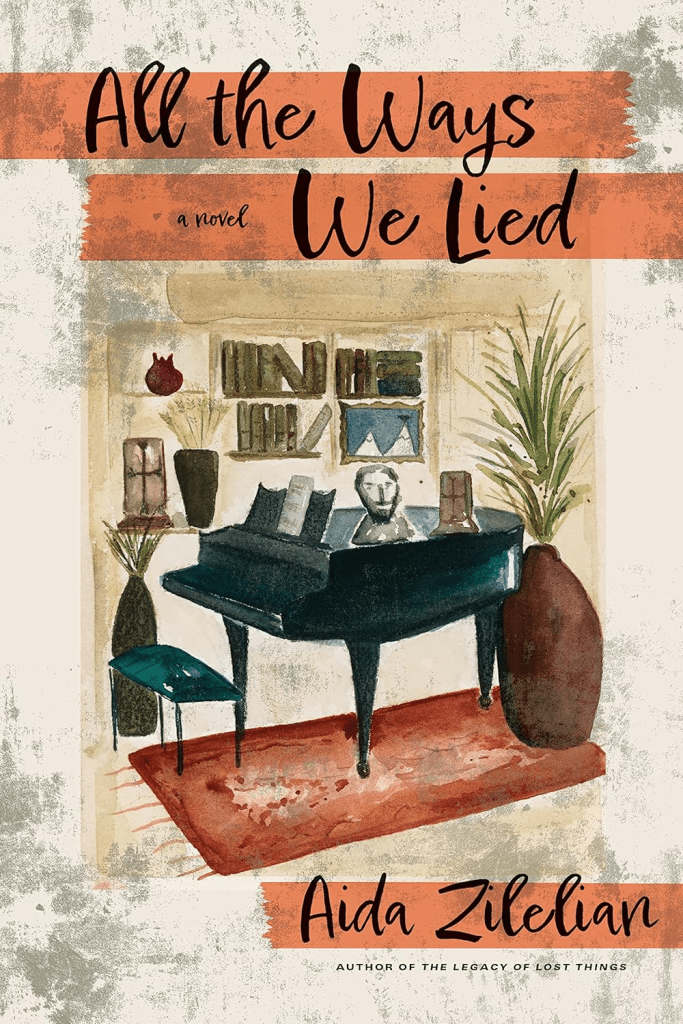
All the Ways They Lied, Aida Zilelian, Keylight Books (January 9, 2024)
Imagine being a member of a quartet that could never play in tune. In Aida Zilelian’s insightful novel set in Queens, New York, we come to know a volatile, tradition-bound, and controlling mother and her three adult daughters, each of them trying to establish their individual needs while trying to find a place at the family table together. That will give you an idea of what it is like in the Manoukian family. There are only fleeting glimpses of these four ever playing in tune.
The novel describes a real family so beautifully that you can easily feel like a member of the family. Even though each episode seems superficially to be about nothing at all, these stories will hold most everything in them. Families like the Manoukians are quickly identified as “dysfunctional,” but their worries, their miscommunications, and the ever-fraying relationships are all too recognizable, all too common. And all too familiar.
In each instance, the daughters will confront some roadblock in their lives and blame the husband, or fate, or the mother, Takouhi. Whatever the reasons, each of them comes to the table with emotional baggage they are both eager and ready to unload and yet not at all ready to unload. Add to the mix a thoughtful but absent father to the two older girls, and a thoughtful but ailing father to the youngest of the three, and it would be hard to imagine a dinner table without conflict on some level.
These are kitchen stories. They are living room stories. The daughters call up memories of their childhood while setting the table, going over a recipe, or cleaning the floors. This is their routine attempt at peaceful domesticity ever at odds with the torment felt by each of them.
Kohar, the eldest, remembers incidents growing up where her mother controlled who she could have as friends, and later opposed her moving out of the house, but to what end? Kohar believes that if she were to confront Takouhi about any of it now, her mother likely would disavow each incident either as if it had not happened or that it must be misremembered. Kohar wonders, “If you can’t even remember what you did, what was the point of it all?” And there is no clear answer.
All the Ways They Lied is exquisitely written, using thoughtful descriptive language that comes across as fresh and innovative, and clear. As the three girls examine their relationships, both with their mother and with each other, it might prompt you, the reader, to rethink your own family conflicts. Very highly recommended.